Apple's ARKit: The World's Largest Augmented Reality Platform in the World, Overnight →

Timothy Buck:

I see a common obstacle for Microsoft, Google and Facebook's entrances into AR. I expect they will all struggle to incentivize enough developers to build a vibrant ecosystem.

Google's Project Tango has been around since 2014, and it is almost universally considered a flop. Project Tango only works on specialized hardware that relatively few people own, and because of that, the software landscape is bleak.

Microsoft's HoloLens was announced in early 2015, and it's really quite impressive by all accounts. But it's not really a consumer product. The HoloLens starts at $3,000 and is marketed as a developer edition. At this point, they have too few users to truly attract developers in large numbers. Obviously, this could change dramatically if they announce a truly revolutionary consumer device.

Facebook's AR Studio is only a few months older than AR Kit, and Facebook has 2 billion users. But at this point, Facebook isn't offering a way for developers to monetize their AR Studio creations. This means it will be filled with AR "apps" that are essentially ads for companies that monetize in other ways.

In the fall, Apple will update their iPhone line and hundreds of millions of iOS devices being used today will be updated to iOS 11 and capable of running ARKit apps. This is serious incentive, and I expect to see a cascade of AR-enabled apps in the App Store at the end of the year.

This is exactly why Apple's stubborn approach to top-to-bottom proprietary/integrated technology pays off.

While everyone else gets bragging rights for beating Apple to market, Apple focuses on becoming first to mainstream adoption.

MIT's Super-Accurate Wireless Speed Measurement Tech →

TechCrunch:

MIT’s Computer Science and Artificial Intelligence Lab has figured out a way of measuring walking speed to within 95 and 99 percent accuracy — all without requiring a wearable or other on-body measurement device. The tech uses wireless signals, dubbed “WiGait” by the research team, sent out by router-like devices within the home to track walking speed and stride length over time.

Based on my theory that Apple will use its iBeacons and Indoor Mapping to supplement Augmented Reality in the real world, I could see Apple acquiring this tech.

Workflow App: The Future of Wearable and Voice-First Apps

Kyle Russell of TechCrunch theorizes that Workflow, an app for iOS power users that was recently acquired by Apple, is a hint at the future of Apple Watch apps:

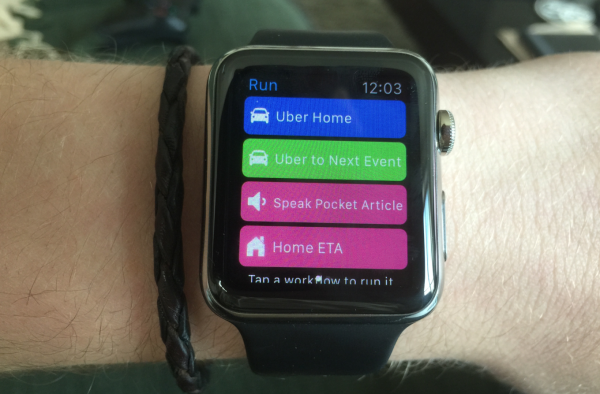
Instead of providing an interface with options to pick from a menu or icons representing actions, Workflow on the Apple Watch has been stripped down to verbs. I want an Uber home, or to the next meeting in my calendar. I’m walking home and want to send an ETA to my roommates. Maybe I’m on BART and it’s just too tightly packed to read on my phone — no worries, I can pick a Pocket article to be read over the headphones plugged into the iPhone in my back pocket.

There are no gestures to remember or content to download to fill a feed. It’s the perfect application for the WatchKit app paradigm, with a single tap executing multiple instructions on the phone. And if, say, a destination or article needs to be picked, the pre-made workflows in the app’s gallery will serve up a few options that users are likely to choose.

Over the coming months, most developers will figure out that the best question to ask themselves when designing smart watch apps is, “What can I help users do with a single tap?” With cameras, LTE, GPS, screen size, and battery life keeping the smartphone relevant for the foreseeable future, developers should assume that users will always have a phone on them for any action that takes longer than raising your wrist, swiping once or twice, and tapping a button or two.

Another supporting argument for Apple breaking down traditional apps into its smallest, simplest actions to make more things possible on the wrist and with your voice.

iPhone 8 with Iris Scanner? →

Seeing sketchy rumors that iPhone 8 may have an iris scanner like the Samsung Galaxy Note 7. I'm still having a hard time seeing how that it better than a fingerprint scanner under the touch screen.

But to Samsung's credit, the most interesting part of having both a fingerprint scanner and an iris scanner is the software aspect — two tiers of security and authentication. Works great for parents who need to protect access to certain data while giving their kids freedom to play games.

A more Apple solution would be to simply let different fingerprints unlock different things instead.

2007: "The iPod Killer" →

Jason Kottke, just after the original iPhone was announced in January 2007:

I guess we know why iPod development has seemed a little sluggish lately. When the Zune came out two months ago, it was thought that maybe Apple was falling behind, coasting on the fumes of an aging product line, and not innovating in the portable music player space anymore. I think the iPhone puts this discussion on the back burner for now. And the Zune? The supposed iPod-killer’s bullet ricocheted off of the iPhone’s smooth buttonless interface and is heading back in the wrong direction.

Sounds just like today, critics preaching a similar narrative: "The iPhone is boring, Apple can't innovate anymore."